

Friday, 16 March 2012
A White Curlew

Tuesday, 13 March 2012
More on Bhutan
 By popular request, I'm writing a little more about Bhutan. So many things about this unique kingdom impressed us. For example, the forest cover statistic. (Click on the picture on the right to see the endless forests behind the farmhouse). Over 60% of Bhutan's original forest cover still survives, and is almost all linked by a web of wildlife corridors. In a mountainous country like Bhutan, most species of birds and mammals migrate up and down the mountains according to season. In most countries, protected areas are small islands in a sea of cultivation; but in Bhutan it's still the other way round. The strong Buddhist ethic sits well with nature conservation too.
  But development is on the way here too. To accommodate the increasing road traffic, huge widening programmes are on the way, resulting in the blasting away of whole hillsides. The dark car at the top centre of the photo (left) shows the scale of this temporary devastation. Not ideal for plants or any other wildlife!
Thursday, 8 March 2012
10 Days in Bhutan

 I am just back from a visit to Bhutan, with an Ornitholidays group. We spent some time admiring the architecture of the dzongs (such As Punakha Dzong, right). A dzong is a fortified monastery that also serves as
local government offices.
I am just back from a visit to Bhutan, with an Ornitholidays group. We spent some time admiring the architecture of the dzongs (such As Punakha Dzong, right). A dzong is a fortified monastery that also serves as
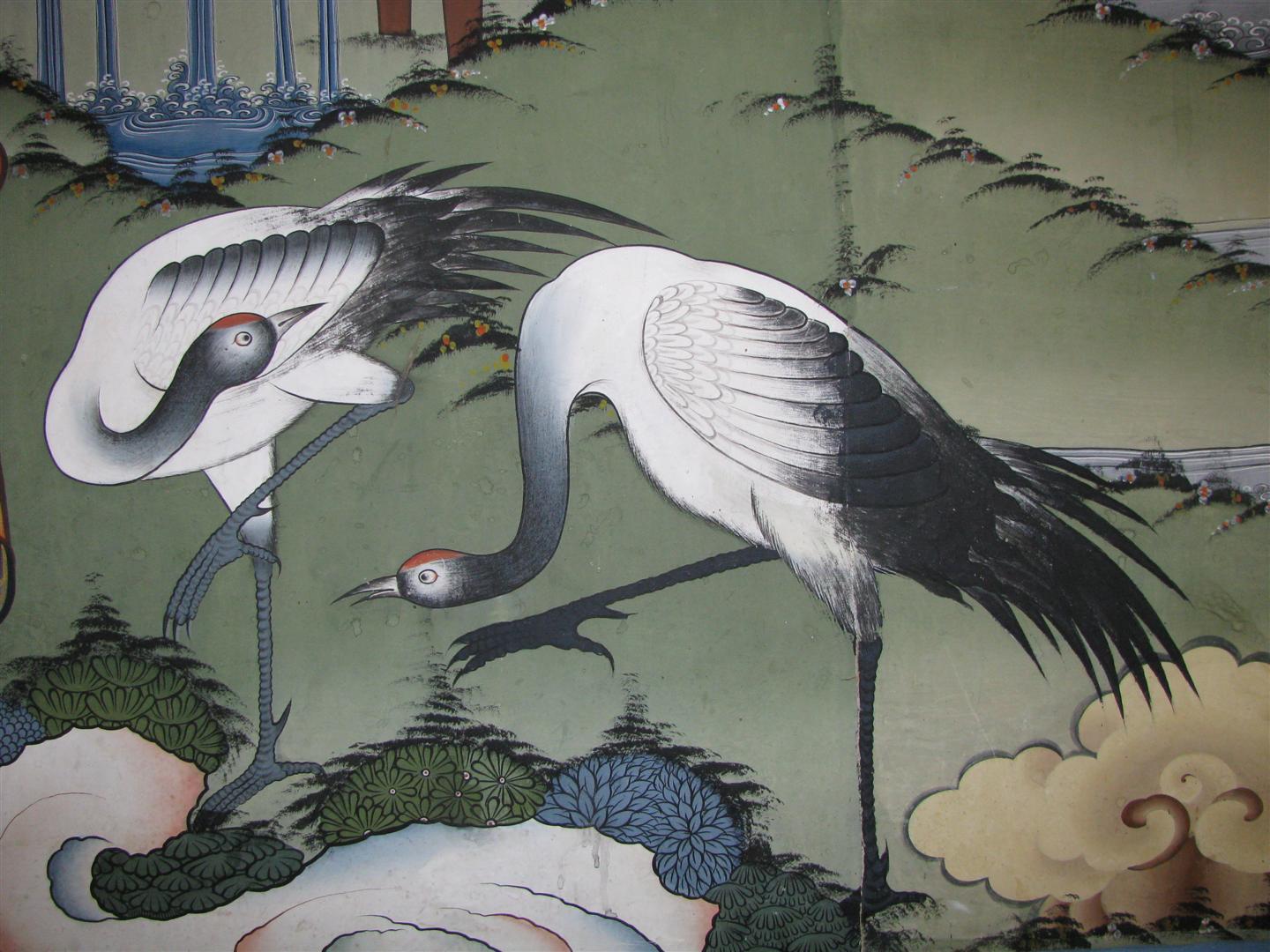
local government offices. Each dzong is full of sacred Buddhist artworks, such as these Black-necked Cranes (right).
 The cranes winter in small numbers in one Bhutan valley, where
we watched about 160 as they fed on tubers and filled the air with loud
trumpeting calls. Here are three of my group aiming for full-frame
photos (right).
The cranes winter in small numbers in one Bhutan valley, where
we watched about 160 as they fed on tubers and filled the air with loud
trumpeting calls. Here are three of my group aiming for full-frame
photos (right). 
 Other easily photographable birds included the Oriental Turtle Dove (left) - as common as a Wood Pigeon at home - and a Spotted Laughingthrush (below left), which was so engrossed in feeding on the verge of a quiet mountain road that it did not notice the approaching photographers.
 Tuesday, 6 March 2012
The roar of a Peregrine stooping....
No photo to accompany this tale, it all happened so fast! In the garden just now, I heard a loud roar like a corrugated iron sheet falling off a roof. Looking up, I saw a Peregrine flying away with prey. Putting a scope on the ash tree it landed in, I saw that we will now have one less Great Spotted Woodpecker at our feeders!
I'll put up something about Bhutan soon!
Thursday, 9 February 2012
Preparing for Bhutan


Friday, 3 February 2012
Otter in the garden!
Here's a short clip of an Otter on the camera-trap in the stream that flows through our garden. Is it a Wales sighting or an English one? Er... Neither, I guess, as the stream itself is no-man's-land between the two! (Blink and you'll miss it).
EDIT: A few days later we caught this on film. (8/2/12)
Friday, 27 January 2012
The Ecotourist's Dilemma


Subscribe to:
Posts (Atom)